
Introduction
In the modern landscape of high-speed protein production, the margin for error is razor-thin—literally. As global supply chains grow more complex, the demand for absolute safety in meat processing has transformed from a regulatory requirement into a competitive necessity. The introduction of AI-based Food Packaging Quality Control has revolutionized how we approach the “final frontier” of food safety: the integrity of the seal.
At WEIGHTSORTING, we’ve seen how traditional methods often fall short in the messy, fast-paced environment of a meat plant. This in-depth guide explores the sophisticated intersection of hardware, like the Stainless Steel AISI 304 Sorter, and software, specifically the vision inspection system, to ensure that Seal contamination (meat in seal) never reaches a consumer’s plate.
The Anatomy of a High-Stakes Environment
Meat processing is uniquely challenging for automated equipment. Unlike dry goods, meat products are moist, irregular in shape, and often processed in environments requiring rigorous sanitation. This necessitates a hardware foundation built from Material Grade SUS304 with an Open Frame Design to prevent bacterial harborage. To maintain a high Throughput without sacrificing safety, every component—from the IP69K Washdown Weight Grader to the AI vision sorting machine—must be designed for extreme durability and precision.
The primary risk in meat packaging is the failure of the seal. Whether it is a tray of ground beef or vacuum-packed steaks, the seal is the only barrier against spoilage and pathogenic growth. Automated Seal Integrity detection is the frontline defense against incomplete seals, wrinkles, and the dreaded Seal contamination (meat in seal). When a piece of protein or a smear of fat gets trapped in the heat-seal zone, it creates a micro-pathway for oxygen and bacteria, rendering the MAP (Modified Atmosphere) Gas Leak Detection useless and leading to a “leaker.”
How AI Vision Sorters Identify the Impossible
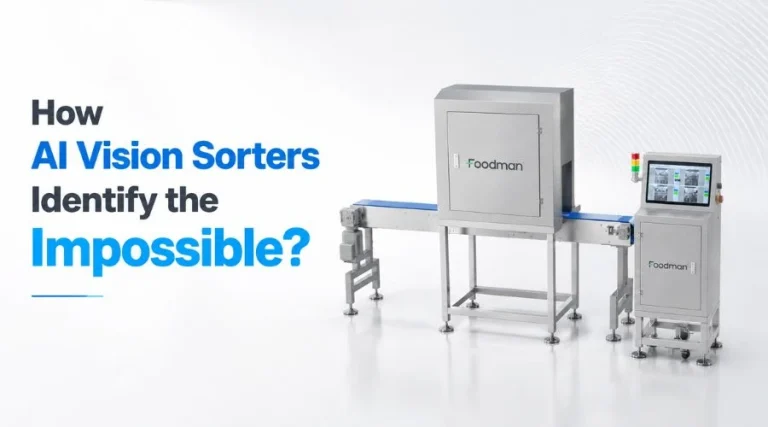
Traditional vision systems relied on “pixel counting” or simple contrast-based algorithms. In a meat plant, where a drop of water or a reflection on the film can look like a defect, these older systems often suffered from an unacceptably high False Reject Rate (FRR). Modern AI-based Food Packaging Quality Control utilizes neural networks that have been trained on millions of images to distinguish between harmless fat smears and critical seal leaks.
The Power of Deep Learning in Seal Integrity
An AI vision sorting machine doesn’t just look for a dark spot; it understands the image’s model. By utilizing deep learning, the vision sorter can identify the Minimum Defect Size that poses a risk while ignoring the non-threatening visual “noise” common in Thermoform Packaging Inspection. This capability is vital for maintaining a consistent Throughput while ensuring that Seal contamination (meat in seal) is flagged 100% of the time.
AI Vision Inspection System for Meat Packaging
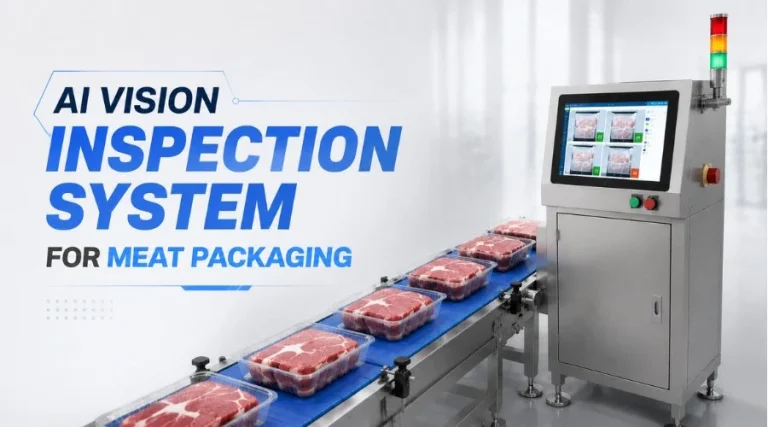
Sometimes the problem isn’t what’s in the seal, but how the meat is sitting under it. An AI Vision Sorter for Meat Packaging analyzes the topography of the tray. If the meat is irregularly shaped, it may cause the packaging to shift during the packaging process, causing incomplete seals or wrinkles. By detecting this before the sealing process, the vision inspection system can divert the tray for manual adjustment, preventing a wasted package.
Advanced Imaging: Seeing the Invisible
Beyond standard RGB cameras, the Meat Packaging Vision Inspection System of 2026 employs advanced imaging modalities to ensure total quality.
Hyper-spectral Imaging for Meat Quality
Standard vision can miss subtle contaminants, but Hyper-spectral Imaging for Meat Quality scans across a broad spectrum of light. The X-ray inspection machine enables AI-powered visual sorting machines to detect and effectively identify residual transparent plastic fragments and other metallic foreign objects in seals. Fat analysis machine can even detect the fat content of minced meat, providing more precise quality assurance for high-end meat production lines. When combined with a Leaking Seal Detector Meat module, hyper-spectral imaging becomes a powerhouse for high-accuracy Automated Seal Integrity detection.
Leaking Seal Detector Meat & MAP Integrity
For products relying on MAP (Modified Atmosphere) Gas Leak Detection, even the smallest “micro-leak” is catastrophic. The Leaking Seal Detector Meat integrates with the vision inspection system to check for the physical presence of the seal and the gas integrity simultaneously. This Combination sorting and Vision System approach ensures that the “invisible” defects are caught just as easily as the obvious ones.
Labeling and Coding: The OCR Revolution

Quality control isn’t just about the seal; it’s about the information. A perfectly sealed steak is a liability if the label says it’s chicken or if the “Use By” date is missing. The Label OCR Verification System within our AI-based Food Packaging Quality Control suite handles these complexities with ease.
Label Skew: The vision sorter identifies if a label is improperly oriented, ensuring brand standards are met.
Incorrect Expiration Dates: Using Optical Character Recognition (OCR), the system reads every printed character to ensure they match the production schedule.
Damage Detection: The Vision Sorting for Packaging Defects checks for tears or scuffs on the label that could hinder consumer readability.
The Hardware Foundation: AISI 304 and IP66K
You cannot run high-level AI-based Food Packaging Quality Control on flimsy hardware. The Stainless Steel AISI 304 Sorter provides the structural rigidity required for the cameras and sensors to remain perfectly aligned even during high-speed vibration.
The Material Grade SUS304 ensures that the machine won’t rust or degrade, while the IP66K Washdown Weight Grader compatibility means you can blast the entire line with high-pressure, high-heat water without damaging the sensitive optics of the AI vision sorting machine. While some secondary components may be IP65, the core of the Combination sorting and Vision System is built for the “washdown warzone.”
How to Calibrate Your AI Vision System for Maximum Accuracy?
To help you get started with the latest technology, here is a guide on optimizing your AI-based Food Packaging Quality Control system.
Step 1 : Establish the Training Baseline
Feed the vision inspection system 500 images of “Perfect Seals” and 500 images of known Seal contamination (meat in seal).
Step 2 : Define the Minimum Defect Size
Configure the software to ignore defects smaller than your safety threshold to prevent an unnecessarily high False Reject Rate (FRR).
Step 3 : Sync with the Sorter
Ensure the Stainless Steel AISI 304 Sorter is perfectly timed with the camera trigger so that the Combination sorting and Vision System rejects the correct package.
Step 4 : Enable Remote Support Capabilities
Connect the system to your network to allow for Remote Support Capabilities for real-time troubleshooting and AI model updates.
Traceability and Data: The Auditor's Best Friend
One of the most powerful features of modern AI-based Food Packaging Quality Control is Traceability Image Logging. In the event of a customer complaint or a regulatory audit, you can retrieve a high-resolution photo of every single package that passed through the vision sorter.
If the system rejected a tray for incomplete seals or wrinkles, the Traceability Image Logging records exactly what the camera saw. This data is invaluable for identifying “root cause” issues—perhaps a specific sealing head is consistently causing wrinkles, or the Throughput is too high for the current film type.
The Future is Integrative: Combination sorting and Vision Systems
Why have two separate machines when you can have one? The Combination sorting and Vision System integrates the IP69K Washdown Weight Grader and the AI vision sorting machine into a single footprint. This allows for:
Weight Grading: Sorting meat by mass using the Stainless Steel AISI 304 Sorter.
Quality Grading: Inspecting for Seal contamination (meat in seal) and label skew.
Space Savings: Reducing the physical footprint on the plant floor while increasing Throughput.
Conclusion
Advanced Detection: AI-based Food Packaging Quality Control uses deep learning to distinguish between harmless fat smears and critical seal leaks, drastically reducing the False Reject Rate (FRR).
Comprehensive Inspection: Optical inspection systems now cover everything from Seal contamination (meat in seal) and incomplete seals to label skew and incorrect expiration dates.
Hygiene First: Equipment built with Material Grade SUS304 and an Open Frame Design ensures food grade safety and allows for IP66K Washdown Weight Grader protocols.
Total Integrity: The integration of AI Vision Sorter for Meat Height/Volume and Hyper-spectral Imaging for Meat Quality identifies defects that are invisible to the human eye.
Data-Driven Safety: Traceability Image Logging and Remote Support Capabilities provide a high level of accountability and uptime for modern meat processors.
Efficiency: The Combination sorting and Vision System offers a streamlined, high-Throughput solution for the most demanding production environments.
At WEIGHTSORTING, we believe that the vision inspection system is more than just a camera—it is the brain of your production line. By investing in an AI vision sorting machine, you aren’t just buying hardware; you are buying the peace of mind that comes with knowing your Automated Seal Integrity detection is the best in the world.
FAQs
How does AI-based Food Packaging Quality Control identify Seal contamination (meat in seal)?
Initial Weight Sorting acts as the first line of efficiency. By using an Industrial Meat Weight Grader, facilities can categorize raw protein by mass before it hits the high-value packaging lines. This process ensures that downstream systems, such as a Multi-channel Weight Sorter or a Circular Weight Grader for Poultry/Beef, receive uniform inputs. This precision minimizes “giveaway” (overfilling) and maximizes Throughput, directly improving the facility’s bottom line.
Can a vision sorter distinguish between harmless fat smears and critical seal leaks?
Yes. One of the primary benefits of AI-based Food Packaging Quality Control is its ability to distinguish between harmless fat smears and critical seal leaks. Traditional systems often flag fat smears on the film as a defect, leading to a high False Reject Rate (FRR). However, modern AI models recognize that a smear outside the seal area is a cosmetic issue, while a smear crossing the seal is a critical hazard. The system is calibrated to a specific Minimum Defect Size to ensure peak safety without unnecessary waste.
What labeling errors does the Label OCR Verification System detect?
The Label OCR Verification System is designed to catch high-risk human or mechanical errors that lead to recalls. It identifies label skew, missing labels, and incorrect expiration dates by reading the printed text in real-time. If the system detects a mismatch between the product and the label—or if the “Use By” date is illegible—the vision inspection system triggers an immediate reject.