
Introduction
In the modern food manufacturing sector, a label is far more than a simple sticker; it is a critical data carrier and a legal contract between the producer and the consumer. At WEIGHTSORTING, we recognize that a single error in a production run—whether it be incorrect expiration dates or a nearly imperceptible label skew—can trigger a multi-million dollar recall and devastate brand trust.
To combat these risks, the integration of a high-performance Optical inspection system has become the industry standard for manufacturers aiming for zero-defect production. This in-depth guide explores the technical architecture of the modern vision inspection machine and how AI-based Food Packaging Quality Control is redefining the standards for Automated Vision Inspection for Food.
The Evolution of Labeling Accuracy: Beyond Simple Presence Detection
Historically, simple sensors were used to detect the presence or absence of a label. However, as global supply chains have become more complex, the need for a Label Content Validation System has skyrocketed. Today’s high-speed production lines require more than “is it there?”; they require “is it right?”.
The modern vision inspection machine employs a combination of Optical Character Recognition (OCR) and Optical Character Verification (OCV). While OCR identifies and reads characters, OCV ensures that the quality and accuracy of the print meet the required standards. In the context of OCR OCV Food Expiry Inspection, this dual-layered approach allows manufacturers to verify that every inkjet-printed date code is legible, accurate, and correctly positioned.
The Role of AI-based Food Packaging Quality Control
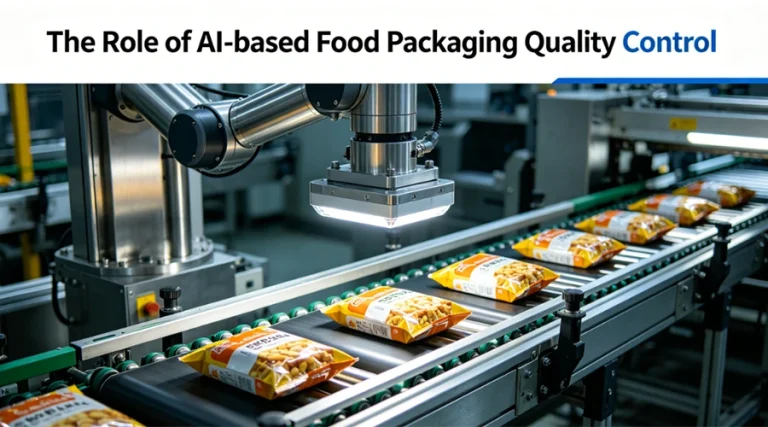
The introduction of AI-based Food Packaging Quality Control has significantly reduced the False Reject Rate (FRR) that plagued earlier systems. By using deep learning algorithms, a modern Optical inspection system can distinguish between a harmless smudge on a package and a critical defect in the barcode. This level of intelligence ensures that Throughput remains high while maintaining the most stringent safety protocols.
Hardware Architecture: The Physical Components of an Automated Vision Inspection for Food
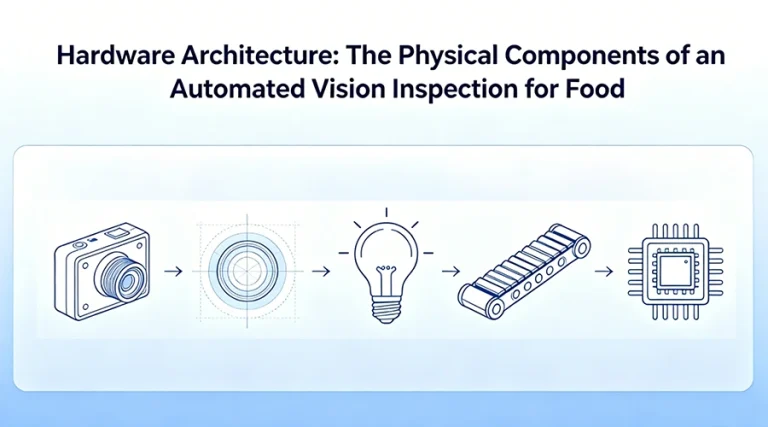
To achieve a 360-degree Barcode Inspection, the hardware must be as robust as the software. At WEIGHTSORTING, we design our systems using a Stainless Steel AISI 304 Sorter framework, ensuring that the machine is capable of withstanding the rigorous washdown environments typical of food processing.
1. Omnidirectional Code Reading Tunnel
For high-speed lines where packaging orientation is unpredictable, an Omnidirectional Code Reading Tunnel is essential. By utilizing a Side/Top/Bottom Package Scanner configuration, the system ensures that every surface of the product is inspected. This setup eliminates “blind spots” and allows for a comprehensive Label Content Validation System check regardless of how the product enters the inspection zone.
2. Industrial Inline Barcode Scanner Technology
At the heart of the system is the Industrial Inline Barcode Scanner. These are not standard scanners; they are high-speed imaging devices capable of processing data at speeds exceeding 600 units per minute. When paired with a Fixed-Mount 2D Code Reader, the system can simultaneously verify 1D barcodes and 2D Data Matrix codes, ensuring compliance with global retail standards.
3. Open Frame Design for Hygiene
Hygiene is paramount. An Open Frame Design in the inspection machine prevents the accumulation of food particles and biological debris. By utilizing Stainless Steel AISI 304 Sorter materials and an Open Frame Design, manufacturers can ensure that their Automated Vision Inspection for Food system remains a hygienic asset rather than a liability.
Technical Deep Dive: OCR vs. OCV in Food Safety
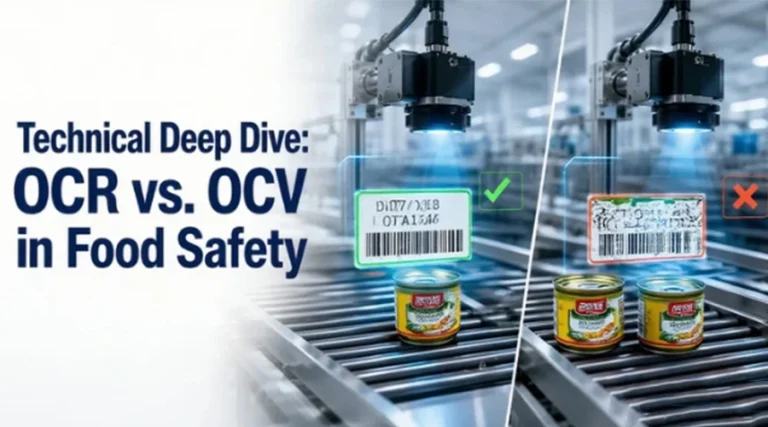
When we discuss OCR OCV Food Expiry Inspection, we are looking at two distinct mathematical processes.
- OCR (Optical Character Recognition): The system takes the image of an inkjet-printed code, segments the characters, and translates them into machine-readable text. This is used to ensure that the code matches the data stored in the ERP-Integrated Traceability System.
- OCV (Optical Character Verification): The system compares the printed character against a “golden template” to check for print quality. If the inkjet printer is running low on ink and the date becomes faint, the vision inspection machine will flag it as a defect, even if the “text” is technically correct.
This distinction is vital for preventing incorrect expiration dates from reaching the shelf. A code that is technically “right” but unreadable by the consumer is just as dangerous as a code that is factually wrong.
The Criticality of Barcode Verification and ISO Standards
In the retail world, an unscannable barcode is a financial penalty waiting to happen. To prevent this, We integrates a Barcode Verification System ISO 15415 into our Optical inspection system.
Barcode Verification System ISO 15415
Unlike a simple scanner that only tells you if a code is readable now, a Barcode Verification System ISO 15415 grades the code based on parameters like contrast, modulation, and axial non-uniformity. This ensures that a barcode printed in your facility will be readable in every distribution center and retail checkout in the world.
Integrating a Fixed-Mount 2D Code Reader with these grading capabilities allows for real-time monitoring of print quality. If the grade drops from an ‘A’ to a ‘C’, the vision inspection machine can alert maintenance before the printer fails completely, preserving Throughput.
Detecting Packaging and Labeling Defects in Real Time
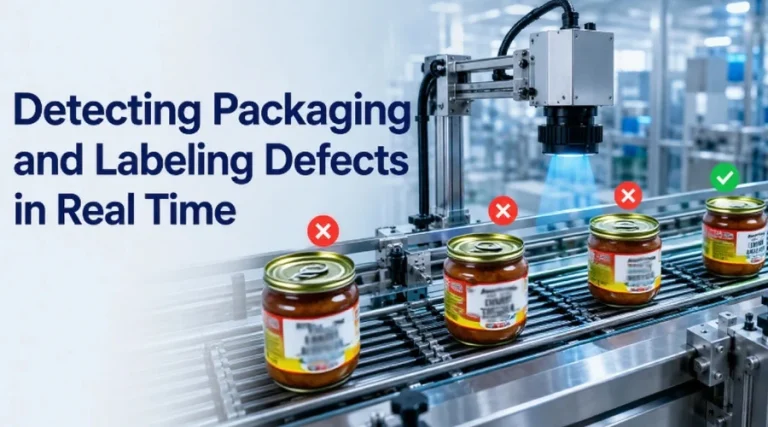
The primary goal of an Automated Vision Inspection for Food is to catch defects before they leave the factory floor. The most common issues detected include:
1. Label Skew and Misalignment
A label skew of even a few degrees can make a premium product look cheap. More importantly, it can prevent an Industrial Inline Barcode Scanner from acquiring the data. Our vision inspection machine uses edge-detection algorithms to measure the angle of the label relative to the package edge, rejecting anything that falls outside of pre-set tolerances.
2. Incorrect Expiration Dates and Missing Codes
Inkjet printers are prone to clogging. A Label Content Validation System constantly monitors the print zone. If a “Best Before” date is missing or contains incorrect expiration dates due to a synchronization error with the ERP-Integrated Traceability System, the package is instantly diverted to a reject bin.
3. 360-degree Barcode Inspection Challenges
On cylindrical packaging, such as bottles or cans, a 360-degree Barcode Inspection is required. By using multiple cameras or an Omnidirectional Code Reading Tunnel, the system stitches images together to form a flat, readable map of the label, ensuring that no part of the code is hidden from the Optical inspection system.
Improving Throughput with Multi-channel Systems
One common concern for manufacturers is that a vision inspection machine might become a bottleneck. However, a properly configured Multi-channel PLC Compatible Barcode Reader actually enhances Throughput. By identifying defects at line speed, the system prevents “downstream disasters” where an entire pallet must be unpacked because a labeling error was caught too late.
The Side/Top/Bottom Package Scanner setup allows for the inspection of multiple product types on the same line. Whether you are running rigid trays or flexible pouches, the AI-based Food Packaging Quality Control adapts its logic to the specific packaging material, ensuring consistent detection of label skew and incorrect expiration dates without slowing down production.
Data Integration: The ERP-Integrated Traceability System
A vision inspection machine should not operate in a vacuum. To achieve true E-E-A-T standards, the inspection data must be part of a larger ERP-Integrated Traceability System.
Traceability Image Logging
One of the most powerful features of our AI-based Food Packaging Quality Control is Traceability Image Logging. For every single product that passes through the line, the system captures and stores a high-resolution image. If a customer complaint arises three months later, the manufacturer can pull up the Traceability Image Logging record to prove exactly what the label looked like when it left the facility.
Ethernet/IP Vision Sensor and Connectivity
Communication is handled via an Ethernet/IP Vision Sensor. This allows the vision inspection machine to communicate directly with a Multi-channel PLC Compatible Barcode Reader. When the ERP system changes the production batch, it automatically sends the new date code and label requirements to the Ethernet/IP Vision Sensor, eliminating the risk of human error during changeovers.
How to Configure Your Optical Inspection System for Zero Defects?
Steps
The Future of Vision Inspection: AI and Hyper-Spectral Imaging
As we look toward the future, the Optical inspection system will move beyond simple light and color. We are already seeing the integration of hyper-spectral imaging into the vision inspection machine. This allows the system to “see” through certain types of packaging to verify the internal contents while simultaneously checking for label skew on the outside.
Furthermore, the AI-based Food Packaging Quality Control will become more predictive. Instead of just rejecting a package with incorrect expiration dates, the system will analyze the trend of print degradation and alert the operator to clean the inkjet head before a failure occurs. This proactive approach to Automated Vision Inspection for Food is the key to achieving 100% uptime and 0% recalls.
Conclusion
Total Verification: A modern vision inspection machine uses OCR OCV Food Expiry Inspection to ensure both the accuracy and quality of inkjet codes.
Comprehensive Coverage: Utilizing an Omnidirectional Code Reading Tunnel and Side/Top/Bottom Package Scanner ensures that label skew and barcodes are detected regardless of product orientation.
Retail Compliance: Implementing a Barcode Verification System ISO 15415 ensures that every code meets the necessary standards for global distribution.
Hygienic Engineering: Systems built with Stainless Steel AISI 304 Sorter materials and an Open Frame Design are essential for food safety and durability.
Data Integrity: Traceability Image Logging and an ERP-Integrated Traceability System provide a digital audit trail that protects brands during disputes or recalls.
Operational Efficiency: Throughput is maximized through the use of an Ethernet/IP Vision Sensor and Multi-channel PLC Compatible Barcode Reader for seamless batch changes.
AI Integration: AI-based Food Packaging Quality Control reduces false rejects and improves the detection of complex defects like incorrect expiration dates.
By investing in a robust Optical inspection system, manufacturers transition from reactive quality control to proactive brand protection. At WEIGHTSORTING, we are committed to providing the hardware and AI-driven software necessary to keep your production lines moving and your labels perfect.
FAQs
How does an OCR OCV Food Expiry Inspection prevent incorrect expiration dates?
The system runs two checks in parallel through a high-speed vision inspection machine. First, the inkjet-printed text is scanned with an Optical Character Recognition (OCR) to verify it matches with the production schedule. The second process is OCV (Optical Character Verification), which compares print quality against a “golden template” to ensure printed text is readable. The OCR OCV Food Expiry Inspection, Dual Layer based. It has the ability to detect missing characters, faint ink or wrong expiry-date detection & Generate a reject signal to the Stainless Steel AISI 304 Sorter in real-time to ensure bad products do not reach the customer.
What is the advantage of an Omnidirectional Code Reading Tunnel for high Throughput?
In high-volume facilities, products often enter the inspection zone in unpredictable orientations. An Omnidirectional Code Reading Tunnel utilizes a Side/Top/Bottom Package Scanner array to achieve a 360-degree Barcode Inspection. This ensures that even if a package is rotated, the Industrial Inline Barcode Scanner or Fixed-Mount 2D Code Reader can capture the data without requiring a mechanical product turner. This significantly increases Throughput while maintaining 100% accuracy in Label Content Validation System checks.
How does a Barcode Verification System ISO 15415 protect my brand?
A standard scanner only tells you if a code is readable now. However, a Barcode Verification System ISO 15415 grades the code based on international quality standards (contrast, modulation, and damage). By integrating this into your Optical inspection system, you ensure that 1D and 2D codes remain readable throughout the entire supply chain. This proactive AI-based Food Packaging Quality Control prevents costly retailer fines and “dead-on-arrival” barcodes at the point of sale.