
Introduction
The global meat processing landscape in 2026 is defined by a relentless drive toward automation, hygiene, and data-driven decision-making. As profit margins tighten and labor shortages persist, processors are shifting from siloed machinery toward a “Total Quality Control” ecosystem. The cornerstone of this evolution is the seamless integration of Initial Weight Sorting with advanced AI-based Food Packaging Quality Control.
At WEIGHSORTING, we have observed that the most successful facilities are those that bridge the gap between raw Weight Graders and final Vision Sorting for Packaging Defects. This “State of the Industry” report explores how a Combination sorting and Vision System maximizes Throughput, ensures MAP (Modified Atmosphere) Gas Leak Detection, and lowers the False Reject Rate (FRR) to unprecedented levels.
Precision Beginnings: The Role of Initial Weight Sorting
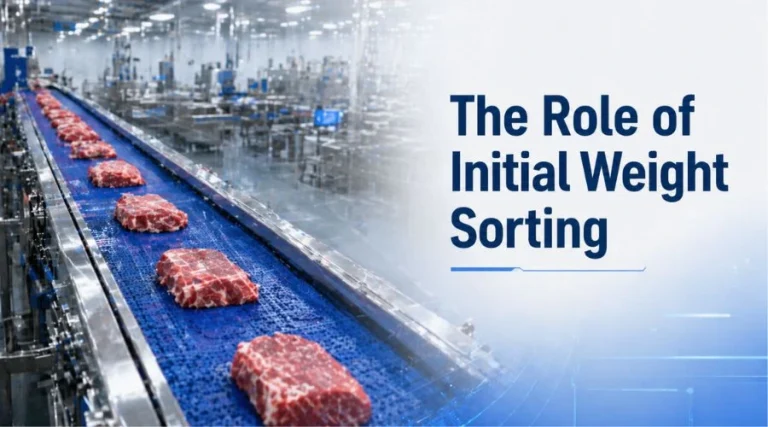
In any protein processing facility, the journey begins with the Initial Weight Sorting phase. Whether dealing with poultry, beef, or pork, the ability to categorize raw product into precise weight classes determines the efficiency of downstream packaging.
Engineering the Industrial Meat Weight Grader
A high-performance Industrial Meat Weight Grader must be more than just a scale categorized according to different weight classes. It must be a rugged, resilient piece of infrastructure. To meet the harsh demands of the meat floor, WEIGHSORTING utilizes a Stainless Steel AISI 304 Sorter construction. This Material Grade SUS304 is essential because it resists the corrosive nature of blood, fats, and harsh cleaning chemicals.
Hygiene and the Open Frame Design
The Open Frame Design has become the industry standard for 2026. By eliminating hollow tubing and hidden crevices, an Open Frame Design allows for a 360-degree washdown. This is vital for maintaining an IP69K Washdown Weight Grader rating, the highest level of protection against high-pressure, high-temperature water ingress.
Optimizing Weight Graders for Throughput
When selecting Weight Graders, processors focus on three primary metrics: Throughput, Weight Range, and accuracy. A Multi-channel Weight Sorter allows for parallel processing, significantly increasing the volume of product handled per hour. For poultry processors, a Circular Weight Grader for Poultry/Beef provides a compact footprint while delivering high-speed In-line Weight Classifier capabilities.
The Packaging Frontier: AI-based Food Packaging Quality Control
Once the product is graded and placed into trays, the challenge shifts from weight to integrity. This is where a Meat Packaging Vision Inspection System becomes indispensable. Traditional sensors often fail in meat environments due to the presence of moisture and irregular product shapes, but AI-based Food Packaging Quality Control thrives in these conditions.
Vision Sorting for Packaging Defects

Modern Vision Sorting for Packaging Defects utilizes deep learning to identify issues that the human eye might miss during high-speed production. The optical sorting machine can detect label skew, wrinkles, or incorrect expiration dates.
Thermoform Packaging Inspection and Seal Integrity
Thermoform Packaging Inspection is particularly challenging because the film is often clear. An Automated Seal Integrity optical sorting machine must be able to distinguish between harmless fat smears and critical seal leaks. While a smear of fat on the seal might be aesthetically unpleasing, a leaking seal detector meat failure leads to spoilage and expensive recalls.
MAP (Modified Atmosphere) Gas Leak Detection
For products using MAP (Modified Atmosphere) Gas Leak Detection, maintaining the gas mix is critical for shelf-life. A Leaking Seal Detector Meat system using infrared or laser absorption can detect trace amounts of escaping CO2, ensuring that every package shipped is truly airtight.
Advanced Imaging: AI Vision and Hyper-spectral Analysis
As we move deeper into 2026, the industry is adopting AI Vision Sorter for Meat technology. This technology can measure the fat-to-lean ratio of meat in a tray.
Hyper-spectral Imaging for Meat Quality
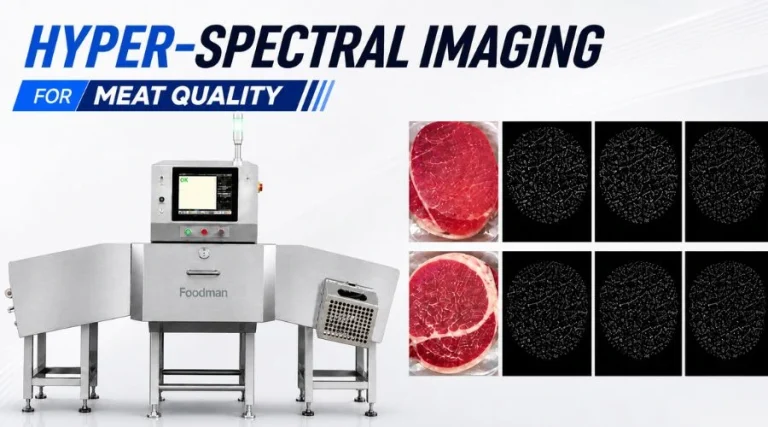
Hyper-spectral Imaging for Meat Quality is being integrated into the In-line Weight Classifier stage. Visual fat analysis system combining X-ray detection technology “sees” the chemical composition of the meat, identifying fat-to-lean ratios and detecting woody breast in poultry or marbling levels in beef.
Label OCR Verification System
One of the most common causes of recalls is mislabeling. An AI-based Food Packaging Quality Control system includes a Label OCR Verification System (Optical Sorting Machine). This system reads the printed “Use By” dates and barcodes in real-time to ensure the label skew or incorrect expiration dates do not bypass the final check.

The true “State of the Industry” breakthrough is the Combination sorting and Vision System. By merging the Industrial Meat Weight Grader data with the Meat Packaging Vision Inspection System data, processors achieve a closed-loop system.
Reducing the False Reject Rate (FRR)
The biggest drain on a facility’s profit is a high False Reject Rate (FRR). AI systems are trained to recognize the Minimum Defect Size while ignoring “noise.” For example, the AI can distinguish between harmless fat smears and critical seal leaks, ensuring that only truly defective packages are removed from the line.
Traceability Image Logging and Audit Trails
Compliance in 2026 requires more than just a pass/fail count. Traceability Image Logging (capturing a photo of every rejected package for audit trails) provides a visual record of exactly why a product was kicked off the line. This is essential for BRC and HACCP audits.
Technical Specifications: From IP65 to Remote Support
When building a high-speed line, the technical parameters must be exacting.
Material Grade SUS304: Every component in the splash zone must be Stainless Steel AISI 304 Sorter grade or higher.
IP Ratings: While the grader requires IP65K Washdown Weight Grader status, the vision cameras often operate at IP65 or IP66 within protective enclosures.
Remote Support Capabilities: To minimize downtime, Easyweigh systems feature Remote Support Capabilities, allowing our engineers to calibrate the AI-based Food Packaging Quality Control software via the cloud.
How To Optimize Your Multi-channel Weight Sorter for Maximum Yield?
Step 1: Calibration of the In-line Weight Classifier. Before starting a shift, calibrate the Industrial Meat Weight Grader using certified weights. Ensure the WeightRange is set correctly for the specific protein being processed.
Step 2: Training the Al Vision System
Feed the Meat Packaging Vision Inspection System 100 “perfect” trays to establish a baseline. Then, feed it known defects,” like incomplete seals or wrinkles to define the Minimum Defect Size.
Step 3: Setting the Rejection Threshold
Adjust the False Reject Rate (FRR) settings. You want to ensure that seal contamination (meat in seal) is caught 100% of the time, while ensuring that small, non-critical aesthetic variations don’t trigger a reject.
Step 4: Enable Traceability Image Logging
Activate the Traceability Image Logging (capturing a photo of every rejected package for audit trails) feature.
This ensures that every reject has a corresponding image saved to the server.
Addressing Common Defects in High-Speed Lines
The integration of Weight Graders and vision helps eliminate the five most common meat processing “Profit Killers”:
Incomplete Seals: Often caused by a drop in heat-sealer temperature or moisture on the tray rim.
Meat in Seal: Using AI Vision Sorter to identify meat fat-to-lean ratios.
Label Skew: Identified by the Label OCR Verification Optical Sorter System.
MAP Leaks: Discovered via MAP (Modified Atmosphere) Gas Leak Detection.
Under/Overweight Trays: Managed by the Initial Weight Sorting stage.
Conclusion
As we have explored in this definitive report, the future of meat processing lies in the fusion of hardware and intelligence.
Weight Grading: Utilizing Stainless Steel AISI 304 Sorter and Circular Weight Grader for Poultry/Beef technology ensures raw product is sorted with high Throughput.
Vision Inspection: AI-based Food Packaging Quality Control prevents recalls by identifying incomplete seals, leaking seal detector meat issues, and incorrect expiration dates.
Data Integrity: Through Traceability Image Logging (capturing a photo of every rejected package for audit trails) and Remote Support Capabilities, facilities can maintain peak performance with minimal manual intervention.
By investing in a Combination sorting and Vision System, meat processors can guarantee a Food Grade environment that meets the strictest global standards while maximizing their bottom line.
FAQs
What is the benefit of Initial Weight Sorting in meat production?
Initial Weight Sorting acts as the first line of efficiency. By using an Industrial Meat Weight Grader, facilities can categorize raw protein by mass before it hits the high-value packaging lines. This process ensures that downstream systems, such as a Multi-channel Weight Sorter or a Circular Weight Grader for Poultry/Beef, receive uniform inputs. This precision minimizes “giveaway” (overfilling) and maximizes Throughput, directly improving the facility’s bottom line.
Why is an IP69K Washdown Weight Grader essential for meat processing?
Hygiene is non-negotiable in protein handling. An IP69K Washdown Weight Grader is engineered to withstand high-pressure, high-temperature (up to 80°C) water jets used during daily sanitation. Combined with a Stainless Steel AISI 304 Sorter construction and an Open Frame Design, these machines eliminate “bacteria traps.” This allows for rigorous cleaning without damaging internal In-line Weight Classifier components, maintaining compliance with global food grade safety standards.
How does AI-based Food Packaging Quality Control distinguish between fat smears and seal leaks?
One of the greatest challenges in meat packaging is “false rejects.” Advanced AI-based Food Packaging Quality Control uses deep learning algorithms trained on thousands of images to distinguish between harmless fat smears and critical seal leaks. Unlike traditional sensors, these optical inspection systems can identify a Minimum Defect Size even in complex Thermoform Packaging Inspection environments. This drastically reduces the False Reject Rate (FRR), saving thousands of dollars in wasted packaging and product.