
Introduction
Selecting the optimal sorting machine is the single most critical engineering decision for plant managers aiming to protect profit margins, maintain regulatory compliance, and eliminate quality control bottlenecks. Whether you are running a high-speed poultry processing line, grading fresh agricultural produce, or managing industrial logistics, your choice of sorting equipment directly governs your overall yield, operational efficiency, and ROI.
At WEIGHTSORTING, we regularly consult with production directors facing a classic engineering dilemma: Should you rely on optical visual surface inspection or dynamic weight/density verification?
While an infrared sorting machine or an ai sorting machine can identify discoloration, structural blemishes, and external defects at blazingly fast speeds, it cannot detect an hollow interior, an under-filled package, or internal density variances. Conversely, an in-line weight classifier measures mass with sub-gram Sorting Accuracy, but remains blind to surface cosmetics.
This comprehensive guide breaks down the technical sorting machinery specs, capital expenditure trade-offs, and operational mechanisms across various types of sorting machines—equipping you with the decision frameworks needed for precise sorting equipment selection.
Technical Comparison Matrix: 5 Core Categories of Advanced Sorting Machinery
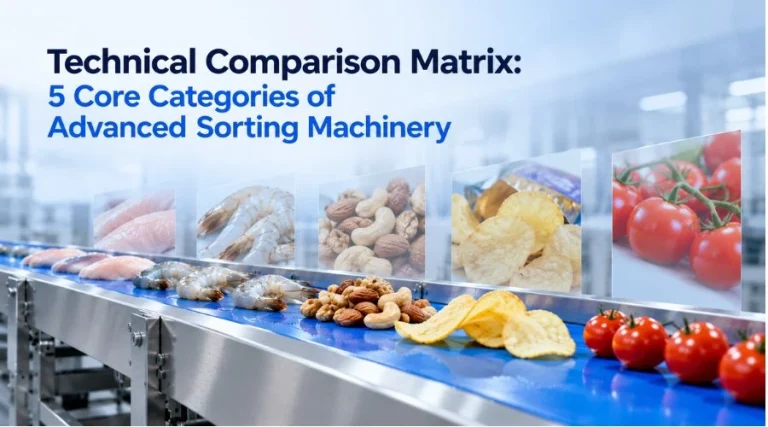
To establish a clear baseline for sorting equipment selection, the following breakdown evaluates Capex, Opex, line footprint, and core detection capabilities across five mainstream industrial types of sorting machines.
| Equipment Category | Capex Tier | Relative Opex | Line Footprint | Primary Detection Capabilities | Key Limitations |
| 1. Vision Sorters (Optical / Color) | Mid-Range Investment | Moderate | Compact to Medium | Color variance, surface cracks, dimensional geometry, exterior defects | Blind to mass, density variations, and internal voids |
| 2. Infrared / Hyperspectral Sorters | High-End Investment | High | Medium | Chemical composition, Brix levels, internal rot, moisture content, polymer type | Sensitive to ambient temperature and calibration drift |
| 3. In-line Dynamic Weight Classifiers | Budget-Friendly Entry | Low | Compact / Modular | Precise individual item mass, batch weight accumulation, under/over verification | Cannot evaluate external aesthetics, color, or surface defects |
| 4. X-Ray & Density-Based Sorters | Enterprise Capital Investment | High | Large (Shielded) | Internal voids, bone fragments, metallic/non-metallic foreign objects | High maintenance, radiation safety compliance protocols required |
| 5. Hybrid Inspection Systems (Vision + Weight) | High-End Investment | Low to Moderate | Integrated / Streamlined | Simultaneous external defect removal and exact weight grading | Requires integrated software architecture |
When to Choose Optical / Infrared Sorting Machines

- Visual Surface Inspection: You need an electronic sorting machine or design vision sorting machine to catch discolorations, skin tears, mold, or sizing deformities.
- Foreign Material Removal: You require sensor based sorting to eject glass, plastics, or organic debris from high-speed processing lines.
Chemical / Internal Composition: An infrared sorting machine utilizes NIR (Near-Infrared) wavelengths to detect sugar content (Brix), moisture levels, or core rot without damaging the product.
When to Choose Dynamic Weight Classifiers
Yield Protection & Giveaway Reduction: Precision weight grading prevents high-value products (such as poultry cuts, seafood, or portioned meats) from being packed over target specifications.
Legal Compliance & Net Weight Checks: Ensuring every packaged box meets strict minimum weight regulations.
Density Verification: Detecting internal voids or inconsistent filling that visual machines that sort cannot see.
How Do Optical Sorters and Dynamic Weight Classifiers Function?

Understanding the underlying physics and engineering principles behind each sort machine is essential for optimizing line throughput.
Optical & Sensor-Based Sorting Technology
An optical sorting machine or ai sorting machine inspects products in flight or along conveyor belts. High-resolution CCD/CMOS cameras, combined with LED or laser illumination, capture surface characteristics at thousands of frames per second. Advanced image-processing algorithms compare each item against pre-configured visual metrics, activating high-speed pneumatic ejector valves to remove defective items within milliseconds.
In density based sorting using NIR spectroscopy, light penetration measures how infrared wavelengths reflect or absorb through the material, providing non-destructive internal analysis.
Dynamic Weight Classification Technology
An in-line weight classifier uses high-precision load cells (Strain Gauge or Electro-Magnetic Force Restoration – EMFR) mounted directly beneath a dynamic weighing belt. As products pass over the weighing platform:
Weight Processing Flow: Product Entry -> Dynamic Sampling -> Digital Signal Processing (DSP) -> Instant Classification
The load cell samples weight signals hundreds of times per second.
DSP filters out mechanical line vibration and ambient noise.
The controller assigns the item to a predefined weight band (e.g., Grade A: 100g–120g, Grade B: 121g–140g).
Physical diverters (flipper arms, drop belts, or air jets) route the item into its designated bin or lane.
WEIGHTSORTING Industrial Machinery Solutions
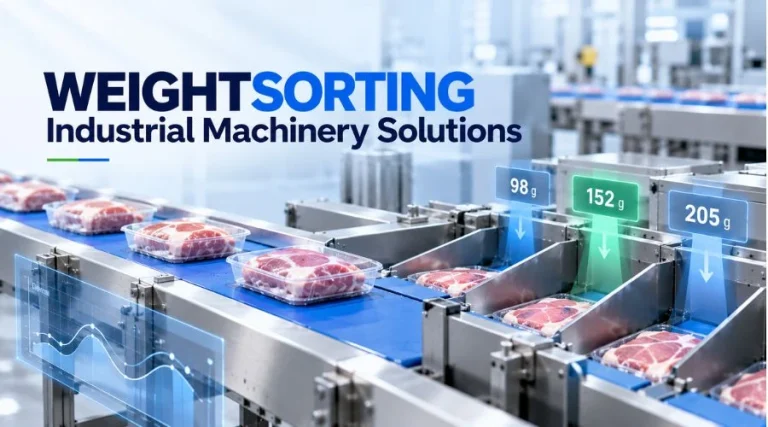
To assist plant managers in achieving maximum line throughput and absolute accuracy, WEIGHTSORTING manufactures five flagship advanced sorting machines engineered for harsh processing environments:
Best For: Streamlined, single-line packaging operations requiring compact footprint and high precision.
Key Specs: Up to 250 items/min, accuracy within $\pm 0.2\text{g}$, IP65/IP66 washdown construction.
Target Applications: Fresh produce portioning, frozen seafood sorting, small poultry cuts.
Best For: High-volume facilities looking to double processing capacity without expanding line footprint.
Key Specs: Parallel weigh belts running up to 500 items/min combined, independent lane control interfaces.
Target Applications: High-throughput meat processing plants, commercial bakeries, high-speed packaging lines.
Best For: Delicate, irregular, or sticky items that tend to slip or roll on traditional belt sorters.
Key Specs: Custom tray shapes, gentle drop mechanisms, throughput up to 180 items/min.
Target Applications: Whole fish, poultry carcasses, delicate fruits (like mangoes or dragonfruit), fragile industrial components.
Best For: Complete quality assurance combining optical defect removal with exact weight grading in a single pass.
Key Specs: Top-down vision system coupled with EMFR dynamic weigh cells; unified touch-screen HMI.
Target Applications: Premium seafood grading, export-grade fruit packing, portion-controlled meat cuts.
Multi-Stage In-line Weight Classifier
Best For: Industrial sorting requiring multi-tier sorting bands (up to 12+ categories) with automated batch accumulation.
Key Specs: High-speed flipper/drop-belt rejecters, real-time statistical analysis, seamless integration with upstream ERP/MES systems.
Target Applications: Bulk food processing, hardware sorting, logistics package classification.
How to Select and Integrate the Right Sorting Equipment?
Required Tools:
Things Needed?
Steps to configure the HowTo widget:
Execution: Compare space requirements. Single-lane inline weight sorters require minimal footprint, whereas vision systems combined with air-rejection arrays require dedicated lighting enclosures and longer stabilization zones.
Execution: Test real product under actual temperature, moisture, and dust conditions. Calculate product giveaway savings to determine your capital payback period.
Conclusion: Driving ROI with Precision Sorting Equipment
Choosing between optical sorters and dynamic Weight Classifiers comes down to understanding your core failure mode. When visual aesthetic compliance and surface defect removal drive your brand value, optical and infrared vision systems provide unmatched control. When product giveaway reduction, exact batch portioning, and legal weight compliance dictate your profitability, dynamic weight classification delivers immediate payback.
For processing environments requiring complete coverage, integrated solutions—such as WEIGHTSORTING’s Visual Inspection & Weight Grader—combine vision and mass verification into a single, high-efficiency inspection point.
Ready to optimize your production line’s throughput and accuracy? Contact the engineering team at WEIGHTSORTING today for a custom line audit, sample testing, and ROI evaluation.
FAQs
What Is the Difference Between an Optical Sorter and a Weight Classifier?
An optical sorter uses camera sensors and light spectra to evaluate surface features like color, shape, and visual flaws. A weight classifier uses dynamic load cells to measure the physical mass of every individual item passing along the production line, regardless of its appearance.
Can Optical Sorting Machines Detect Internal Product Defects?
Standard visual vision sorters cannot see inside products. However, infrared sorting machines (NIR) and X-ray inspection systems can analyze density variations, moisture, sugar levels, and internal voids by measuring light absorption or radiation transmission through the item.
How Accurate Are In-line Weight Classifiers at High Speeds?
Modern in-line weight classifiers equipped with Digital Signal Processing (DSP) achieve dynamic accuracies within 0.1g to 0.5g at line speeds exceeding 250 to 300 pieces per minute, depending on product stability and belt vibration controls.