
Introduction
Every year, modern high-speed food and manufacturing facilities lose millions of dollars due to an invisible operational leak: False Reject Rate (FRR).
When configuring a automated sorting machine on an active processing line, engineers and procurement teams often focus primarily on throughput speed and primary defect detection rates. However, if your sorter machines are incorrectly calibrated or lack advanced algorithmic discrimination, perfectly good products end up in the rework or scrap bin.
An In-line Weight Classifier operating with even a 1.5% False Reject Rate (FRR) can throw away hundreds of thousands of dollars in “good product” waste annually. At WEIGHT SORTING, our data-driven engineering approach demonstrates how balancing Sorting Accuracy with raw Throughput directly transforms your bottom line.
In this guide, we break down the mathematics of False Reject Rate (FRR), evaluate different types of sorting machines, explore how sensor based sorting and AI sorting machine technologies cut giveaway, and provide a step-by-step guide on configuring your automatic sorting machines for maximum yield.
What is False Reject Rate (FRR) in an In-line Weight Classifier?
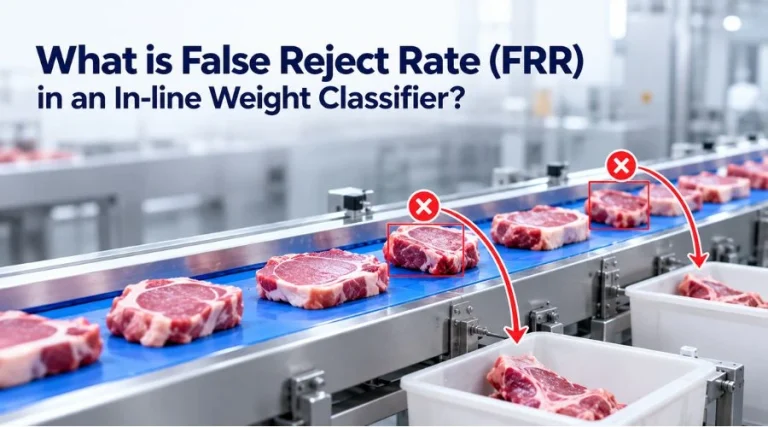
The False Reject Rate (FRR) represents the percentage of fully compliant, high-quality products wrongly identified as non-compliant (overweight, underweight, or defective) and rejected from the primary stream by an auto sorter machine.
While the False Acceptance Rate (FAR) measures non-compliant products slipping into the final packaging (causing regulatory fines or brand damage), False Reject Rate (FRR) measures internal operational cash drain.
In high-speed processing, dynamic factors—such as structural belt vibration, draft air currents, and rapid line acceleration—interfere with the load cell signal of an electronic sorting machine or In-line Weight Classifier. When software misinterprets signal noise as weight deviation, a compliant product is ejected into the reject bin.
How do you calculate the financial cost of FRR?
To calculate your annual financial loss due to a high False Reject Rate (FRR) on a dynamic weight sorting equipment line, use the following formula:
Annual Financial Loss = Total Units Processed/Year X FRR (%) X Unit Cost of Good Product
Financial Impact Case Study: High-Speed Poultry Line
- Line Speed: 250 units per minute
- Operating Hours: 16 hours/day (2 shifts), 300 days/year
- Total Volume: 250 * 60 *16 *300 = 72,000,000 units/year
- Average Product Cost: $0.45 per unit
| FRR Percentage | Good Units Rejected Annually | Direct Annual Financial Loss | 5-Year Profit Drain |
| 0.2% (Easyweigh AI Sorter Standard) | 144,000 units | $64,800 | $324,000 |
| 1.0% (Industry Average Checkweigher) | 720,000 units | $324,000 | $1,620,000 |
| 2.5% (Uncalibrated Standard Sorter) | 1,800,000 units | $810,000 | $4,050,000 |
Reducing the False Reject Rate (FRR) from 1.0% down to 0.2% on a single dynamic sort machine saves $259,200 annually.
How do different types of sorting machines impact False Reject Rates?

Different sorting machinery architectures process physical characteristics using distinct sensor mechanisms. Selecting the right machine type for your specific density, speed, and geometric variation directly determines your Sorting Accuracy.
1. In-line Weight Classifiers
An In-line Weight Classifier uses strain gauge or Electro-Magnetic Force Restoration (EMFR) load cells integrated into a conveyor belt.
Primary Challenge: Mechanical vibrations from neighboring motors or uneven belt splices cause weight spikes.
FRR Vulnerability: Without dynamic digital filtering, sudden vibrations cause compliant items to read artificially heavy or light, creating high false rejection rates.
2. Design Vision Sorting Machines and Optical Sorters
A design vision sorting machine uses high-speed industrial CCD or CMOS cameras to analyze product color, shape, size, and structural orientation.
Primary Challenge: Organic shape irregularities, minor surface shadows, or harmless moisture reflections.
FRR Vulnerability: Conventional rule-based software flags benign organic variations as defects, purging clean product into waste containers.
3. Infrared Sorting Machines
An infrared sorting machine utilizes SWIR (Short-Wave Infrared) or NIR (Near-Infrared) sensors to inspect invisible material properties, such as internal moisture content, sugar levels, or foreign polymer presence.
Primary Challenge: Dust accumulation on sensor lenses or subtle variations in surface temperature.
FRR Vulnerability: Dust or lens smudges lower light transmission, causing the system to misidentify clean products as defective.
4. Advanced AI Sorting Machines
Modern advanced sorting machines combine physical weight classification with sensor based sorting driven by deep learning models. By pairing an ai sorting machine with dynamic EMFR load cell arrays, the system evaluates multiple data points simultaneously—effectively eliminating false rejects caused by environmental noise or harmless visual blemishes.
Why do automatic sorting machines experience high false rejects in factory environments?

In laboratory conditions, machines that sort operate in isolated, climate-controlled environments with zero floor vibration. However, real-world processing plants introduce severe environmental interferences.
Key Environmental Drivers of FRR Spike:
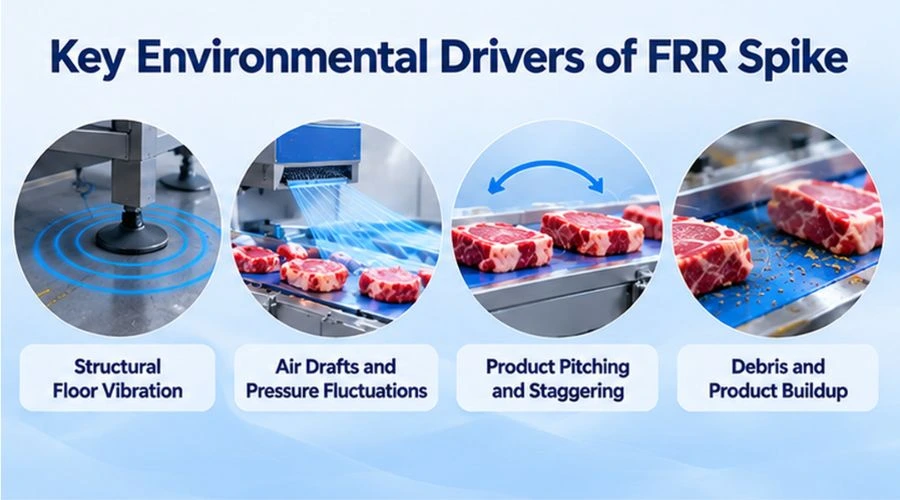
Structural Floor Vibration: Heavy packaging equipment, forklifts, and compressors transmit mechanical shockwaves through the plant floor. This shakes the dynamic weighing bed, introducing signal noise into the weight calculation.
Air Drafts and Pressure Fluctuations: High-speed HVAC units, overhead cooling fans, and protective air knives exert downward or upward force on sensitive weigh belts, distorting mass readings.
Product Pitching and Staggering: Irregular spacing between incoming items causes two products to hit the weigh belt simultaneously (double-product error), leading the auto sorter machine to reject both items.
Debris and Product Buildup: Dirt, fat deposits, or liquids accumulating under the weigh belt alter the tare balance of the electronic sorting machine, causing zero-point drift.
How to reduce False Reject Rates?
To configure an In-line Weight Classifier or automatic sorting machines for minimal false rejects, field technicians must follow a structured calibration protocol.
Action: Install rubber-metal isolation mounts.
Target: Eliminate ambient floor vibration frequencies below 50 Hz.
Action: Enable automatic zero-tracking (dynamic taring) to compensate for gradual product residue accumulation on the belt.
Target: Maintain tare stability across full operational shifts.
Action: Feed organic product variations (harmless color shifts, minor shape deviations, moisture variations) into the training dataset.
Target: Establish an accurate confidence threshold that ignores non-defective product anomalies.
Action: Calibrate photoelectric optical encoder sensors to track exact item positions.
Target: Achieve millisecond-accurate pneumatic ejection targeting only non-compliant items.
Key Performance Indicators: Comparing Machine Classifications
When evaluating the best sorting machines for high-volume lines, compare critical operational metrics beyond initial equipment purchase price:
| Performance Metric | Standard Mechanical Sorter | Advanced Electronic Sorter | WEIGHT SORTING AI Weight Classifier |
| Primary Technology | Strain Gauge Load Cell | EMFR Sensor Array | EMFR + Sensor Fusion AI |
| Average FRR (%) | 2.0% – 3.5% | 0.8% – 1.5% | < 0.2% |
| Maximum Throughput | Up to 150 ppm | Up to 300 ppm | Up to 500+ ppm |
| Vibration Immunity | Low (Requires rigid floor) | Medium (Internal software dampening) | High (Active Structural Noise Cancellation) |
| Organic Variety Tolerance | Poor (High false rejects) | Moderate | Superior (Deep Learning Adaptation) |
| Annual Product Giveaway | High | Moderate | Lowest in Class |
Why Easyweigh Is the Industry Standard for High-Accuracy Weight Sorting?
Reducing your False Reject Rate (FRR) requires equipment built specifically for high-speed industrial environments. WEIGHT SORTING’s suite of advanced sorting machines, In-line Weight Classifiers, and sensor based sorting systems combine precision load cells with intelligent processing software.
The WEIGHT SORTING Advantage:
Sub-Gram Precision at High Speeds: Achieve accurate dynamic weight classification at throughput speeds exceeding 500 items per minute.
Integrated AI Deep Learning: Our ai sorting machine models differentiate true weight and dimensional defects from acceptable organic variations, cutting false rejects to under 0.2%.
Industrial Structural Isolation: WEIGHT SORTING sorter machines feature built-in vibration dampening frames that reject plant floor interference.
Instant ROI: By halting good product giveaway, an WEIGHT SORTING In-line Weight Classifier typically pays for itself within 3 to 6 months of continuous operation.
FAQs
What is False Reject Rate (FRR) in an automatic sorting machine?
False Reject Rate (FRR) is the percentage of fully compliant, non-defective products mistakenly identified as defective and rejected by an automatic sorting machine or in-line weight classifier. A high FRR results in ‘good product’ waste, directly lowering yield and operational profitability.
How does an AI sorting machine improve sorting accuracy over conventional machines that sort?
Unlike standard machines that sort based on rigid, single-threshold parameters, an AI sorting machine utilizes deep-learning models to analyze organic variations (like minor shape or surface shifts). By fusing visual data with dynamic load cell signals, AI-driven auto sorter machines maintain high throughput while keeping FRR below 0.2%.
How can operators calibrate dynamic weight sorting machinery to reduce false rejects?
To minimize FRR on sorting machinery, operators should isolate the sort machine frame from plant floor vibrations, enable dynamic digital FFT filters, use automatic zero-tracking (taring) on the electronic sorting machine, and calibrate reject air-blast timing to prevent adjacent compliant items from being inadvertently knocked into the reject bin.